
| Zhoujun Cao c.zhoujun@wustl.edu (A paper written under the guidance of Prof. Raj Jain) |
Download |
Intent-Based Networking (IBN) is an extension of policy-based management. It is a three-layer architectural model comprising the Business Layer, the Intent Layer, and the Network Layer, ensuring intent translation, enforcement, and assurance.
In this context, this paper presents current IBN applications across industrial and communication networks. It also explores the development of AI-driven IBN systems that use Artificial Intelligence, Large Language Models, Deep Reinforcement Learning, and Retrieval-Augmented Generation to achieve cognitive understanding, adaptive control, self-healing, and other capabilities. Additionally, this paper outlines directions for potential future research.
Keywords: Intent-Based Networking, Intent, Network Automation, AI, Closed-Loop Control, Cognitive Networking, 6G, Intent Modeling, Policy Management
In recent years, the rapid development of various communication technologies has become increasingly complex and requires large-scale management of network infrastructures. Modern network infrastructures are becoming more dynamic and globally responsible. However, the traditional way to configure and manage devices and operating systems by specifying everything from scratch does not provide the level of scalability and robustness. Traditional methods for maintaining systems on an industrial scale, based on manual interventions in configurations, are becoming more costly and time-consuming. These days, systems are costly and competitive. They are required to be consistently fast, maintainable, responsive, and flexible, while requiring little or no intervention from administrators.
As most of the existing drawbacks are caused by the static and device-oriented nature of conventional network management, the primary weaknesses are as follows. First and foremost, manual configuration inevitably results in inconsistencies, sluggish performance and response time, and human mistakes, which are the last things one can afford when adapting to incessant policy changes or supporting real-time services [Saha18][Wei20]. Even though Policy-Based Network Management automates to some extent, the logic of “if–then” requires formulating exact rules and behavior in response to every single instance. Therefore, these approaches lack agility and intelligence and prove to be inapplicable to future paradigms such as 6G, industrial IoT, and autonomous networks.
One paradigm designed to address these issues is Intent-Based Networking (IBN). Focused on goal-oriented network operation, IBN does not require users to define the exact systems and settings they wish to apply. Instead, they articulate the outcomes they expect to be achieved: minimal latency to critical applications, secure exchange of data over cloud domains, and so on. This information is analyzed by the IBN system, which translates the high-level objectives into executable configurations. After translation, it automatically enforces the settings and tracks the system to detect whether it follows the intended objectives. This setup ensures that the whole infrastructure is efficient and flexible. As suggested by Cisco [Cisco24], IBN is controller-led and enables users to record their business intent and apply it to the infrastructure.
Building on these foundations, this paper provides an overview of IBN. It covers the abstract principles and architecture of IBN, the latest research progress, and its current applications and future development.
This chapter provides the concept and architecture of IBN. In addition, it discusses how IBN differs from existing networking approaches by comparing it with traditional network management, policy-based network management, and software-defined networking.
Intent is a high-level, declarative statement. It expresses a desired operational or business goal without specifying the detailed method of implementation. Put differently, it states what the system should achieve without dictating how. The automation and control system that sits underneath the declaration determines how later.
Historically, intent emerged as a natural evolution in the management of network devices. Policy-based approaches were developed to assist the administrator in managing the devices. Previous-generation policy models were based on Event–Condition–Action rules that specified the human-defined ECA flow. Initially, the systems required the human administrator to prescribe exact device configurations that they wished to achieve. While these paradigms worked adequately in the pre-cloud era, modern network environments switched to a more dynamic and service-based operation mode. A more abstract, goal-oriented approach was needed to describe the desired behavior automatically and reason about the context.
Taking the concept of intent as a starting point, Intent-Based Networking is an intelligent, goal-oriented model for the work of networks, which translates the concept from configuration to control and optimization of the entire cycle to the user-declared intent. IBN systems convert business goals into policies, start the corresponding configurations, and monitor the state of the system to understand whether it behaves as expected, after which it is possible to make a conclusion or force an adjustment [Zeydan20][Leivadeas22] [Cisco24]. The IBN model is usually a closed-loop control system with four key stages:
Unlike traditional systems that rely on manual rule definition, IBN leverages advances in AI, machine learning, and telemetry analytics to achieve real-time adaptation and decision-making. In summary, IBN replaces device-level and static configurations with goal-oriented automation, creating a self-configuring, self-optimizing, and self-healing networking environment [Wei20][Zeydan20].
As illustrated in Figure 1, Intent-Based Networking has three layers: Business Layer, Intent Layer, and Network Layer [Zeydan20].
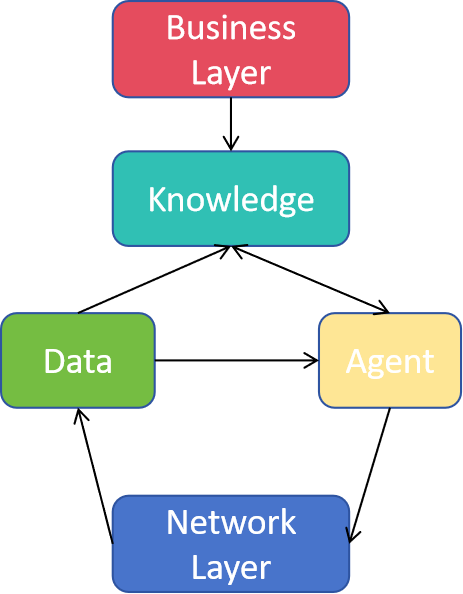
In the Business Layer, administrators or applications express high-level intentions in natural or policy-based languages, such as service-level objectives or operational constraints. These intents then pass down to the Intent Layer, acting as the brain of the architecture. This layer consists of three critical components – Knowledge, Agent, and Data – which closely collaborate to understand, reason, and actuate intents. The Knowledge module includes ontologies and models for understanding semantics. The Agent module translates and composes actionable configurations. The Data module gathers observations from the underlying network, performs modeling, and tracks learning to keep the current context of intent updated. In the Network Layer, the physical and virtual infrastructure domains, such as radio, transport, core, and IoT networks, execute the actions generated by the Intent Layer and provide telemetry back to close the loop of automation.
The Business Layer is the highest layer of abstraction where high-level business intents are defined by human operators or applications. It includes:
The Intent Layer is the key of an IBN system. High-level intents are decomposed into composite configurations, and their consistent matching with network states is guaranteed. This layer consists of three modules [Zeydan20]:
Together, these three modules establish a closed-loop automation cycle that monitors the environment and triggers adaptive actions to maintain intent compliance.
The Network Layer is the underlying physical and virtual infrastructure. It performs the context-dependent actions from the former layers and produces operational data. It includes:
| Layer | Main Characteristics |
|---|---|
| Business Layer |
|
| Intent Layer – Knowledge |
|
| Intent Layer – Agent |
|
| Intent Layer – Data |
|
| Network Layer |
|
Table 1: Characteristics of Layers in Intent-Based Networking Architecture [Zeydan20]
Traditional network management relies heavily on manual configuration through device-specific command-line interfaces (CLI). As networks grow in scale and complexity, manual operations may result in configuration inconsistencies and can be time-consuming. In contrast, IBN introduces a high-level, goal-oriented abstraction that allows users to specify what they want instead of how to achieve it. IBN automates the entire lifecycle, forming a closed-loop system capable of continuously maintaining the desired network state. Thus, IBN enhances agility, reduces human error, and provides significantly better scalability.
Policy-Based Network Management defines network behavior based on the Event–Condition–Action (ECA) paradigm. In this model, an event triggers the evaluation of a predefined condition; if the condition is satisfied, the system executes the corresponding action. Policies therefore describe how the network should react under specific conditions.
IBN differs by operating at a higher abstraction level. Intents describe desired outcomes without specifying operational details, allowing the system to autonomously derive the necessary policies and configurations. Moreover, IBN incorporates continuous monitoring and assurance mechanisms. Therefore, IBN can be viewed as an evolution beyond PBNM.
Software-Defined Networking (SDN) separates the control and data planes and provides the foundational mechanisms that enable external applications or controllers to configure the network dynamically. However, SDN itself does not define high-level goals.
IBN builds on SDN by adding a higher semantic layer. Rather than configuring flow rules explicitly, users express intent in natural or structured language. The IBN system then uses SDN as an enforcement backend to translate intents into low-level configurations. Consequently, SDN serves as a key enabler for IBN, while the two address different layers: SDN provides programmability, whereas IBN provides autonomy and intent-driven operation.
This chapter introduced the fundamental concepts and architectural principles of Intent-Based Networking (IBN). It clarified the notion of intent, presented IBN as an intelligent, closed-loop networking paradigm, described its three-layer architecture, and compared it with three existing networking approaches.
This chapter reviews the current applications of Intent-Based Networking (IBN). It discusses traditional implementations and explores recent advances in artificial intelligence (AI).
Intent-based networking has developed from a holistic approach of networking to a transformative blueprint to automate the network management process in the industry and telecom domains. The initial implementations were essentially limited to easing complex configuration tasks, streamlining agility, and minimizing running expenses. In industrial settings, the IBN perspective aims to tightly align industrial network systems with business goals via the orchestration of services based on intent. Saha et al. [Saha18] discussed automated intent-driven service delivery on industrial control systems, mainly applicable to Industry 4.0 environments that demand real-time responsiveness and reliability. They also introduced a new intent interface concept intended to converge operational technology and information technology domains into coherent interaction.
Zeydan and Turk expanded this foundation. In their survey of the state of the art in IBN research [Zeydan20], applications are divided into three fundamental domains: policy-based network control, service orchestration, and QoS optimization. They considered IBN systems as the next logical evolution of policy-driven management, providing a more cognitive and autonomous mechanism for configuration and assurance.
Extending these ideas into the 6G space, Wei et al. demonstrated how IBN principles are key enablers of ultra-reliable low-latency communications and network slicing [Wei20]. IBN enables operators to translate service-level objectives into slice configurations that dynamically manage heterogeneous devices, spectrum, and edge-computing workloads. Beyond radio and core networks, IBN concepts can also be applied to data provenance and accountability.
Ujcich et al. introduced provenance models [Ujcich20] that allow traceability of the policy lifecycle for compliance and transparency between autonomous systems. Provenance metadata was incorporated natively into the IBN controller to provide auditable context information. Similarly, Velasco et al. [Velasco21] demonstrated an end-to-end IBN architecture for multi-domain optical networks featuring cross-layer intent negotiation and run-time performance assurance.
Recent studies by Leivadeas and Falkner [Leivadeas22] and Gharbaoui et al. [Gharbaoui23] show that IBN is now being tested in real-world systems. Major vendors and standardization bodies such as Cisco, ETSI, and IETF are starting to use intent models in their network tools to automate services, speed up troubleshooting, and improve performance in real time. Together, these studies show that IBN has moved from a conceptual idea to a practical technology, and it is an important step toward networks that can manage and control themselves.
The next evolution phase is the integration of Artificial Intelligence (AI) into Intent-Based Networking. As a result, IBN evolves into a new concept called AI-Driven Intent-Based Systems [Njah25].
Njah et al. [Njah25] introduced an AI-based Intent-Based Network Architecture (IBNA). The new architecture aims to make networks fully automatic. Their model has three main steps: refinement, activation, and assurance. It uses AI tools such as Large Language Models (LLMs) to understand user goals and Deep Reinforcement Learning (DRL) to solve problems and verify results. In addition, the system keeps learning from feedback, which helps it work independently.
Zeydan et al. [Zeydan25] expanded this idea to industrial automation. They used generative AI to connect business goals with factory actions. By allowing people to communicate with machines in a common language, the system makes factories smarter and easier to control.
Wang et al. [Wang25] continued this work by using LLMs and Retrieval-Augmented Generation (RAG). RAG improves how IBN understands user intents. Their research showed that LLMs with RAG can help the system better understand what users mean in different situations. This new AI-based IBN can better understand context and explain its actions. As a result, AI-driven IBN systems make networks more adaptive and intelligent.
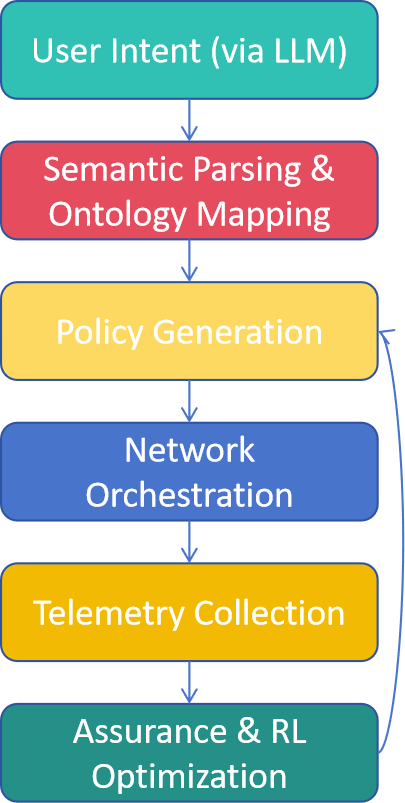
Figure 2 illustrates the overall workflow of an AI-driven Intent-Based Networking system. In this pipeline, user intents are interpreted by LLMs, mapped to an ontology for semantic understanding, converted into policies, orchestrated across the network, and optimized through telemetry-driven assurance and reinforcement learning.
Even though Intent-Based Networking has made significant progress, there are still several challenges. Future work can focus on the following directions.
(1) Better understanding of intents and context
[Zeydan20][Wang25]
IBN can turn clear goals into actions, but it has trouble understanding complex or unclear
business needs. Future systems should use Large Language Models to better capture meaning
and context.
(2) Working across different network domains
[Velasco21][Leivadeas22]
Most IBN systems only work inside one type of network. To connect many different systems
together, new frameworks need common standards and methods to keep policies consistent
across all networks.
(3) Clearer and more explainable systems
[Njah25][Gharbaoui23]
Today’s IBN systems sometimes act like “black boxes”, making it hard for people to trust
them. In the future, they should include explainable AI (XAI) and better data feedback so
people can understand and verify what the system is doing.
(4) Self-learning and reliable IBN
[Wei20][Wang25]
The next generation of IBN should be able to learn, improve, and fix itself. By using
reinforcement learning, shared intelligence, and trustworthy AI, networks can grow and
adapt on their own while staying safe and reliable—helping reach the full potential of
IBN in 6G and beyond.
This paper introduced the core ideas and architectural foundations of Intent-Based Networking. It reviewed current applications of IBN in industrial and communication networks and highlighted recent progress in AI-driven approaches. However, IBN is not perfect. Challenges include reliable intent interpretation, multi-domain coordination, and maintaining transparency as AI-driven systems become more complex. Addressing these challenges will be essential for realizing fully autonomous, intent-driven networks in future generations of communication systems.
AI: Artificial Intelligence
API: Application Programming Interface
DRL: Deep Reinforcement Learning
ETSI: European Telecommunications Standards Institute
IBN: Intent-Based Networking
IBNA: Intent-Based Network Architecture
IoT: Internet of Things
KPI: Key Performance Indicator
LLM: Large Language Model
ML: Machine Learning
ONF: Open Networking Foundation
OT: Operational Technology
PBNM: Policy-Based Network Management
QoS: Quality of Service
RAG: Retrieval-Augmented Generation
RFC: Request for Comments
SLA: Service-Level Agreement
SLO: Service-Level Objective
SDN: Software-Defined Networking
URLLC: Ultra-Reliable Low-Latency Communication
XAI: Explainable Artificial Intelligence
ZSM: Zero-Touch Service Management